
October 31, 2018
The caffenol unit began with the class learning about Single Lens Reflex cameras, the film they use, how the film works/the chemistry behind it, and the equipment necessary to develop film. We created latent images by exposing both black and white 35mm film and color film in Cannon Rebel 2K cameras. Once our latent images were captured onto the emulsion, our students the learned to process the film using caffenol. Instant coffee was mixed with distilled water, and adding sodium carbonate, Vitamin C (ascorbic acid) and potassium bromide.
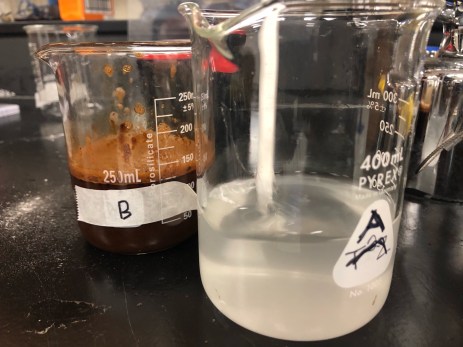
The developer was made by making two solutions, A and B, and mixing them together and pouring the resulting solution into the developing tank. Solution A was made by dissolving 17.5 grams of sodium carbonate in 150-mL of distilled water. Solution B was made by dissolving 25.0 grams of instant coffee, 5.0 grams of Vitamin C, and 0.5 grams of potassium bromide in 100-mL of distilled water.
Once the developer was made, our students put the film into developing tanks and developed them! They started by soaking the color film in water for 5-8 minutes. This process softens the emulsion, and removes the color dye. Next they agitated the film in the caffenol developer for 12-15 minutes. Then, they took the film from the developer and placed it into a stop bath of constant agitation, repeatedly inverting the tank for a minute. This stops the developing process. Then, they took the film out of the stop and placed into the fix. This process will remove the excess silver from the film. The last process is to agitate in photo flow 30 sec-1 minute.


Next, our students created two enlargements of their favorite negative. They did this by using an apparatus cleverly named an enlarger, that simply projects light through a piece of film thus printing the image onto a piece of photographic paper. One of the prints was developed using traditional Dektol developer, and one print was developed with caffenol. Each print was soaked in the appropriate developer. Developer is a basic solution that causes the silver metal atoms in the latent image to reduce the silver ions around them, to more silver metal atoms. It takes about 90 seconds for the silver atoms to reach a high enough concentration to be seen with the eye. At this point the image is now visible on the paper. After developer, our students soaked each paper in what’s called the stop. Stop is an acidic solution that neutralizes the basic developer. This reaction stopped the developer from interacting with the latent image, essentially ensuring the picture isn’t too dark. Finally, the paper was soaked in the fix to get rid of any light sensitive silver ions left on the paper, thus making it light safe. The Dektol print is on the left and the caffenol print is on the right in the images below.


The caffenol process was very successful for our students. Both the film and the enlargement of the film came out well. The color film was difficult to develop, as the film had to soak in water for a very long time before in order to get the excess ink out of the film. If this was done incorrectly, the image came out smudged and difficult to see. The black and white film developed especially well, and some students even said it came out better than the normal Dektol developer. Developing the photographic paper enlargements was very interesting. When the paper was developed it, came out slightly faded and rustic, with a yellow-brownish tint.
 Experimental Photography MHS
Leave a comment